


A bicycle’s steering doesn’t affect its fit, but it does affect handling and how the bike behaves in the situations a rider encounters. I’m not referring to the headset as an individual component with its bearings and cups — I mean the whole assembly that controls how the bicycle handles.
The evolution of the bicycle and its geometries has brought with it measurements that affect steering and handling. These measurements are rake, trail and wheel flop.

The construction of the first bicycle came about because of an extraordinary natural event: the eruption of Mount Tambora, located on the island of Sumbawa, Indonesia, which erupted on 10 April 1815. It was the largest recorded volcanic eruption in history.
The eruption caused major climatic anomalies, leading to the well-known volcanic winter. 1816 is known as ‘the year without a summer’: in the Northern Hemisphere — particularly Europe and North America — the worst famine of the 19th century was endured.
In Germany, Baron Karl von Drais de Sauerbronn witnessed first-hand the death of horses due to a lack of food. Driven by necessity, in 1817 he created a mechanical horse on wheels. He fitted it with a steering mechanism so it could be controlled: the first bicycle in history, the Draisine.

When a rider wants to buy a new bicycle, they know how important it is to choose the right size.
But there are other aspects that don’t affect the size, yet do shape how the bicycle behaves — and that directly affect the rider. These are dimensions that influence the handling of the bicycle, the rider’s safety and even performance. When a bicycle is easy to control, the rider’s satisfaction grows.
Science is in constant development and research in the field of cycling. Experts have shed light on the dynamics of two-wheeled motion, and the AAAS (American Association for the Advancement of Science) even carried out a study in 2011 that established the requirements for a bicycle to be self-stable.
A riderless bicycle can automatically steer itself to recover from turns and avoid falling over. The common view is that this self-steering is caused by the gyroscopic precession of the front wheel, or by the contact of the front wheel trailing behind the steering axis. We show that neither effect is necessary for self-stability. Using linearised stability calculations as a guide, we built a bicycle with extra counter-spinning wheels (cancelling the spin angular momentum of the wheels) and with its front-wheel ground contact placed ahead of the steering axis (making the trail distance negative). When given a sideways push while rolling in a straight line, this bicycle automatically recovers and returns to upright. Our results show that several design variables, such as the location of the front mass and the tilt of the steering axis, contribute to stability through complex forms of interaction. — American Association for the Advancement of Science · Science Magazine
Scientific advances have led makers to adopt the basic parameters that govern how the bicycle behaves. Some have a greater impact than others, but all lead back to the same component: the bicycle’s steering. It’s what helps us keep our balance and handle the bike.
In this video from NewScientist magazine you can see how the bicycle stabilises itself, together with a contraption that cancels the gyroscopic effect using discs that spin in the opposite direction to the wheels.
You can read the full article at the following link:
Reinventing the wheel: designing an ‘impossible’ bike
What is bicycle steering?
The steering system is located at the front of the bicycle and is what allows us to manoeuvre and steer it as we wish. A bicycle’s steering system is made up of the handlebars, the stem, the fork and the headset.
In earlier posts I detailed how the stem affects the bicycle’s behaviour. There I talked about Rake, Trail and the head angle. But we shouldn’t forget the Offset — or fork offset — and Wheel Flop.
All the components that make up the bicycle’s steering play a part in its behaviour, yet there are measurements and figures we’re unaware of that are crucial when designing a bicycle.
Thanks to the advances of the last decades, new measurements have been added to geometry design to improve the behaviour and handling of bicycles. The first measurement taken into account was the head angle, but…
How does bicycle steering work?
Most of us remember our first rides on a bike and the panic of the front wheel veering off course. When that happened, no matter how much we tried to turn the handlebars to keep the wheel straight, it was useless — the bicycle always tipped over. It happened because we were letting our body fall to the same side as the wheel.
It was solved the day we learnt to control weight distribution and the dynamics of motion.
In the animation you can see a computer-generated model of a bicycle and a passive rider, demonstrating an uncontrolled but stable weave. (Source: Wikipedia)
It’s similar to balancing a broomstick on the palm of your hand: when it’s about to fall, you move your hand towards the side it’s tipping.
When riding a bicycle there are moments when we need to lean with it, such as taking corners. In these situations the steering is essential so the rider can control the lean and bring the bicycle back upright.
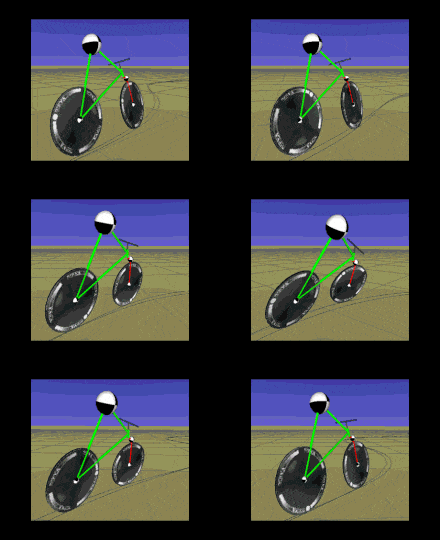

The steering therefore plays a very important role in keeping the bicycle under the rider’s control.
You can see this when a bicycle makes lateral movements at low speed: in these moments, the rider struggles to control the steering to keep the bicycle upright. In fact, whenever a rider has trouble controlling the bicycle, you can be sure they’re trying not to fall.
How do you ride a bicycle?
There are two important points for riding a bicycle.
The first is control from the handlebars. By intuitive logic and as set out above, a bicycle without steering couldn’t be ridden, something we all understand. Riding a bicycle is something we all learn through practice, and it becomes a subconscious process both for guiding the bicycle and for maintaining balance.
The second point of control is the saddle. Have you ever walked beside a bicycle holding it only by the saddle? In this exercise, if you tilt the saddle to one side, the handlebars fall in the same direction. The same happens when we ride no-handed: our legs, moving out to one side or the other, control the steering.

When speed is low, controlling the bicycle from the handlebars is fundamental; but at high speeds, steering control is more important from the saddle, though neither excludes the other.
Practice improves every skill and studies bear this out. In this case, the scientific journal PLOS ONE provides a study on the skill of balancing while riding a bicycle, “On the Skill of Balancing While Riding a Bicycle”. Below is the translation of the study’s abstract.
Humans have ridden bicycles for over 200 years, yet there are no continuous measures of how skill differs between novices and experts. To address this knowledge gap, we measured human-bicycle dynamics in 14 subjects, half of whom were experts and half of whom were novices. Each subject rode an instrumented bicycle on training rollers at speeds ranging from 1 to 7 m/s. Steering angle and rate, steering torque, bicycle speed and bicycle roll angle and rate were measured, and steering power was calculated. A force platform beneath the roller assembly measured the net force and moment that the bicycle, rider and rollers exerted on the ground, allowing the lateral positions of the system’s centres of mass and of pressure to be calculated. Balance performance was quantified through the cross-correlation of the lateral positions of the centres of mass and of pressure. The results show that all riders exhibited similar balance performance at the slowest speed. However, at higher speeds, expert riders achieved superior balance performance by employing more rider-lean control (quantified by the cross-correlation of rider lean angle and bicycle roll angle) and less steering control (quantified by the cross-correlation of steering rate and bicycle roll rate) than novice riders did. Expert riders also used a smaller steering control input with less variation (measured by average positive steering power and the standard deviations of steering angle and rate) and less rider lean angle variation (measured by the standard deviation of rider lean angle) regardless of speed. — Stephen M. Cain, James A. Ashton-Miller, Noel C. Perkins
How does steering affect bicycle geometry?
We’ve established that steering is a fundamental part of how a bicycle behaves and, no less so, of its geometry. It has a major impact on handling.
The head angle, wheel flop, and the rake and trail of the fork, together with stem length, handlebar width and tyre profile, play an important role in the front wheel’s response as the rider interacts with the steering.
There are other measurements that also affect how the bicycle behaves and relate to steering. Bottom bracket drop, wheelbase and seat tube angle determine the weight distribution of the rider-bicycle system. That’s why, when designing a geometry, all these parameters must be considered together.
What is the head angle of a bicycle?

It’s the angle formed by the head tube (Head Tube) relative to the horizontal plane (the ground). It directly influences how the bicycle behaves. A very steep head angle will help on climbs and will be stable on flat sections, with a more comfortable position and handling. It also makes the bicycle’s directional behaviour more direct, nervous and unstable on descents. A slack head angle is used on enduro and downhill bicycles where we need the bicycle to be stable and to attack obstacles very well.
Extract from… What is the geometry of a bicycle? »
This is the easiest to understand. The head angle dictates how much effort is required to turn the front wheel. As the head angle increases, it becomes easier to turn the wheel.
A bicycle’s steering is more than just an angled tube; it shapes how the bicycle is controlled.
What are the Trail and Rake of a fork?
The trail of a fork is the distance between the tyre’s contact point with the ground and where the imaginary line of the head tube meets the ground.
It’s important that the Trail sits behind the fork’s imaginary line in order to give greater control of the bicycle. At high speeds it helps the wheel remain stable without rider input. However, if the Trail is too large, the bicycle will be difficult to handle.

Trail is often confused with fork offset. It’s fundamental to the geometry design of the bicycle, because it affects the handling of the front wheel. The greater the trail, the slower and more stable the steering will be at high speeds. Although when tackling tight corners the bicycle will feel heavier and harder to turn. Downhill bikes, for example, have a high trail.
To achieve a more responsive steering feel that reacts faster to input, with the consequent gain in handling, you need to reduce the trail.
Trail depends on three factors: the head angle, the Rake (fork offset) and the wheel size.
If you keep the Rake and wheel size constant but slacken the head angle, Trail increases. The same happens with Rake: reduce it and both Trail and the head angle increase.
So, as the head tube angle decreases, the wheel’s contact patch on the ground moves further from the steering axis. This makes it easier for the wheel to self-centre. Stayer Bikes are an example: a negative Rake increases Trail, which adds stability at high speeds.
In the image below you can see how, keeping the Rake constant and increasing the Trail, the head angle decreases.

Source: cyclingtips.com
As Rake increases, Trail decreases, making it harder for the front wheel to stay in line with the bicycle on its own. If we increase the Rake even further, the Trail becomes almost imperceptible, and could even turn negative; in that case the steering becomes very sensitive, to the point of being uncontrollable at low speeds.
What is a Stayer Bike? They were velodrome racing bicycles, specifically for motor-paced races. In the early twentieth century, Stayer Bikes had to meet certain requirements. The front wheel had to be smaller (24”) and the fork had to be inverted. These peculiarities allowed the rider to sit a little closer to the motorbike, but with high handlebars to allow maximum breathing without losing the aerodynamic draft created by the motorbike. The seat tube angle and the rider’s position were brought forward over the bottom bracket. The handlebars were also brought forward by increasing stem length. These adjustments shifted the rider further forward and placed more weight on the front wheel. Because of the forced positions of the components and the forces exerted by the riders, these bicycles needed reinforcements to prevent flex and avoid unexpected failures. These bicycles reached speeds of 60–70 km/h with peaks of up to 100 km/h.

What is Wheel Flop?
Wheel Flop is similar to trail, since it’s set by the fork’s Rake and the head tube angle. The main difference, however, is how the position of the front axle changes when a rider turns the handlebars. In the vast majority of geometries, the axle height drops as the handlebars are turned. This phenomenon is more pronounced with a slacker head tube angle, as well as with forks that have less offset.
In the chart below you can see how the greater the Rake, the lower the Wheel Flop and the steeper the head angle.

Source: cyclingtips.com
This means wheel flop lets a bicycle turn with less effort at low speeds. A bicycle with more Wheel Flop makes a sharp turn far easier at low speed than one with less flop. The optimal wheel flop, therefore, is the one in balance with the Trail. While it improves handling, too much Wheel Flop makes a bicycle hard to keep in a straight line.
In the image below you can see how Wheel Flop varies with different head angles and Rake. It comes from Rodfordbuilt, where Rob explains how Wheel Flop affects cargo bikes. He makes it clear that a cargo bike needs a steep head angle (78.69°) and almost zero trail to strike the best compromise between handling with and without load.

Source: http://www.rodfordbuilt.co.uk
To make this easier to see, take a look at the following image.
When the rear wheel is higher than the front, the steering will be more reluctant to turn because there is very little Wheel Flop. However, as we raise the front wheel, less effort is needed and it becomes impossible to keep the steering centred.

Wheel Flop counteracts Trail: they are inextricably linked. As one increases, so does the other. It is not possible to build a bicycle with a lot of Trail and little wheel flop.
Some common combinations of head angle and Rake (for example, 71°-55 mm, 72°-49 mm, 73°-43 mm or 74°-37 mm) produce a trail of 59 mm with a 700×25 tyre, but the amount of Wheel Flop steadily decreases from 18 mm to 16 mm.
Why doesn’t a bicycle fall over in corners?
It happens thanks to the gyroscopic effect.
If we hold a wheel with both hands by the axle and spin it while tilting it, we’ll feel a force pushing to straighten the wheel. This effect means that the wheel, when leaned over in a corner, helps us bring the bicycle upright again.
This force helps keep the bicycle stable at high speeds. Though stability isn’t always desirable. A good example is lightweight wheels: we all look for light, responsive wheels to gain agility, but with a consequent loss of stability.
How does stem length affect a bicycle’s steering?
Stem length produces behaviour similar to fork Rake. It can modify the steering response, but on a smaller scale.
I’ll cover the most specific points here, since you can see everything in much more detail in the article I wrote on the bicycle stem. I’ve left the link in the button below.
Everything you need to know about the bicycle stem »
We start with the following image, the steering arc. This depends on stem length. The shorter the stem, the more sensitive the steering is to hand and arm movement, and vice versa.

Stem length also affects how much of the rider’s weight sits over the front wheel. A clear example would be these two situations:
- A short frame with a long stem.
- A long frame with a short stem.
With a long stem, more of the rider’s weight rests on the front wheel, with the result that it will be slower to respond.
With a short stem, more of the rider’s weight falls on the centre and rear of the bicycle, so the front wheel will be quicker to respond.
This doesn’t help much if the head angle is very slack or the fork has a lot of Trail. Nowadays, MTB bikes have been getting longer and shifting to short stems.
How does handlebar width affect the bicycle’s handling?
Handlebar width behaves much like stem length. Wide handlebars move the hands away from the centre of the bar, enlarging the steering arc. Conversely, narrow handlebars create a smaller arc and ultimately a quicker, more responsive steering feel. This improves handling, but if we pair it with a short stem the steering can become too twitchy.
Road handlebars with more or less drop, or MTB bars with more or less rise, also affect this behaviour in terms of the steering arc.
Have you ever tried descending with your hands resting on the stem? The handlebars also help to stabilise the rider’s body.

How does tyre width affect the bicycle’s steering?
The wheel diameter increases with tyre width, which in turn increases trail. Going from a 700×23 tyre to a 700×32 adds 2 mm of trail, while a 700×45 will add 4 mm.
These differences will also be affected by the internal rim width, which will give the tyre more or less volume.


To a lesser extent, the same happens with wheel flop.


There is also the tyre’s contact patch with the ground, which acts against any force applied to the steering. As the tyre gets wider, that contact patch grows; this helps the wheel stay aligned with the steering and encourages it to return to centre after a corner.
This explains why on a road tyre the effect is barely noticeable; whereas on a much wider MTB tyre, the bicycle and its steering slow down, making it more stable at high speeds. Conversely, the steering becomes far more twitchy and precise at low speeds.
How does bottom bracket drop affect the bicycle’s steering?
Though it may seem irrelevant — and to a large extent it is — it does play a role in the rider’s position and centre of gravity.
A low bottom bracket places the overall weight closer to the ground, which helps increase the bicycle’s stability.
This distance can be measured in two ways: the drop relative to the wheel axle line, or the distance from the centre of the bottom bracket to the ground. The first measurement is the one that helps us determine the centre of gravity.

It is also crucial how the rider distributes weight across the wheels. The wheelbase and the centre of the bottom bracket to the centre of the front wheel measurement are very important dimensions in this regard.
You can read much more about these measurements and how they affect the behaviour of the bicycle and the rider in the post I wrote on bicycle geometry.
What is bicycle geometry like? »
A bicycle’s wheelbase
We all know what wheelbase means. This measurement is largely determined by the length of the frame.
The wheelbase sets the stability and handling of the bicycle, but there’s another very important factor that also influences behaviour: the distribution of the rider’s weight. This can shift between the front and rear wheel depending on where the bottom bracket is located.
The distance between the centre of the bottom bracket and the front axle is usually greater than that between the centre of the bottom bracket and the rear axle (60/40), because the front wheel needs room to turn from side to side, while this also influences the weight distribution over that wheel. The head angle and the fork’s rake also play a role in the weight distribution, since these two measurements alter the distance between the centre of the bottom bracket and the front axle.
Conversely, the distance from the centre of the bottom bracket to the rear axle is only affected by the chainstay length.
This length difference (60/40) means the rear wheel carries more weight, provided the rider holds a neutral position on the saddle. Triathlon and time-trial bicycles use handlebar clip-ons; beyond aiding aerodynamics, they bring an increase in weight over the front wheel, which improves stability and prevents oscillation at high speeds. On the other hand, steering corrections become harder and less precise.
As I explained earlier, reducing the weight on the front wheel results in more reactive, nervous steering. This situation increases the risk of oversteer or loss of tyre grip. A bicycle in these conditions becomes very unstable at high speeds, with behaviour that’s very hard to control and demands more effort and concentration.
A clear example is touring bicycles. When rear panniers are added, the front wheel tends to wander at low speeds, and the effect becomes even more persistent at high speeds. On this kind of bicycle it’s always advisable to use front panniers or a handlebar bag to add weight over the front wheel and not diminish handling.

Ultimately, finding the balance in weight distribution depends on many factors that have to be considered when building a bicycle. A proper adjustment lets the rider enjoy the benefits of a balanced bicycle. In some cases people choose to alter the proportions understood as standard (60/40) by swapping the stem or changing the saddle position. But this option isn’t advisable — unless the adjustments are millimetric — since it completely changes the steering behaviour along with your position on the bicycle.
For example, on a road bike, altering the horizontal position of the saddle can affect pedalling efficiency.
This is one of the key points of building custom bicycles: the optimisation of weight distribution to achieve a refined, distinctive product.
How does the rider’s behaviour affect that of the bicycle?
Weight distribution is very relative, since the rider, depending on the situation, will keep shifting the weight towards one wheel or the other, even from side to side. These are involuntary movements in response to the bicycle’s behaviour and the terrain.
The type of bicycle and the rider’s experience/skill can determine the stability and handling of the bicycle. A novice rider on a bicycle with a steep head angle and short trail will struggle to control the steering; an experienced rider, on the other hand, will have no trouble at all controlling it.

All these aspects are also influenced by the situation, the type of terrain and the cycling discipline. It’s not the same to take a ride through a park as to head into a forest at high speeds or weave through traffic in New York.
The rider’s habits will largely determine the riding style and the control they have over the bicycle. At the same time, each person’s sensory capacity is different: that threshold will be different for each rider, so they’ll behave differently in similar situations.
And, naturally, riding the bicycle will bring experience and improvements in control, handling and stability for the rider.
The blend of measurements
How do we bring all these parameters together to understand the steering behaviour of a bicycle?
There’s no easy answer. The behaviour of bicycles with different dimensions and in different situations has been studied, but the main problem is the rider — a mass that falls outside the equations of these studies.
Jodi Kooijman carried out a study on “Modelling the cyclist” in which he examined different individuals in different situations. You can download the full study at this link. I’ll also leave you a short excerpt from the abstract:
To this end, observational experiments have been carried out to discover what control actions a rider performs on a bicycle, and the observed rider movements have then been implemented in a passive rider model. Furthermore, it has been experimentally demonstrated that the almost universally accepted requirements for bicycle self-stability — spin angular momentum (the gyroscopic effect) and trail — are not necessary.
Ultimately, empirical testing is what has been improving the behaviour of the bicycle for just over two hundred years. Industrial development and science helped sharpen our understanding of the data. The riders’ feedback was interpreted in order to develop the kind of bicycle and steering behaviour we know today.
There are thousands of data points from these tests, but they clarify nothing, since they derive from cause-and-effect associations. We understand what works and what doesn’t, but we don’t know why.
A bicycle can be built with a wide range of angles, but if we review the geometry charts of 100% of makers and compare models from the same discipline, we can conclude that they all adopt the same ranges of dimensions.
There are certain nuances that result from the variations makers implement, and they’re often imperceptible. But when these variations are driven by the rider’s needs, the result can be very satisfying. Custom framebuilders have managed to refine the art of adapting the geometry to the rider without focusing on what trends, standards or industry-set values dictate.
Geometry should be based on the fit, biomechanics and anthropometry of the rider, their riding style, their experience and their cycling discipline.
Conclusions
The behaviour of the bicycle has been developing year after year for two centuries: evolution has given us data that had never been known before.
Field trials and testing are showing how new bicycle and fork geometry designs influence its steering and handling. Even more so when the trials and testing have focused on parameters like head angle, trail or rake. These have proved to have a greater impact on a bicycle’s steering behaviour than others, but without forgetting that all of them together are necessary to achieve a satisfying result.
I’ve always been against those who criticise the princess in “The Princess and the Pea”: she was able to feel a pea beneath a stack of mattresses; I apply that to the experience and sensations that different materials and dimensions bring to a bicycle.
After everything you’ve read, I’ll tell you that there are still those who say that varying the chainstay length by a few millimetres or reducing the head angle by one degree can’t be perceived in the behaviour of the bicycle. Some even say there’s no difference between the sensations two handlebars of different materials provide, let alone different lengths.
That’s why I think that, even though geometry together with the behaviour of the bicycle remains something mysterious, opening the mind and connecting the senses when riding will help us experience and assess some of the nuances of its handling. It’ll be the only way to educate ourselves and learn more about the variety of experiences we can have with small changes to the steering geometry and to the bicycle in general.
