


You crest the climb and begin the descent.
You let yourself roll calmly, barely pedalling. You grip the handlebars and rest your fingers on the brake levers. Speed builds as you guide the bicycle through the bends and feel the air on your face.
But suddenly you feel that the bicycle starts to vibrate, and within seconds the vibration grows violently. You do everything you can to stay upright and keep the bicycle under control. After a few terrifying seconds picturing yourself on the ground, you manage to brake on the verge and put your feet down. In that moment you feel a huge relief.
You set off again, but much more slowly than before. The shimmy effect is one of the most terrifying things that can happen on a bicycle.
In this post I’ll explain what the shimmy effect is, why it happens and how to avoid it.
What is the shimmy effect?
Speed wobble, or shimmy, can be defined as “a vibration of the bicycle’s handlebars at frequencies too high for the rider to respond to effectively”. It’s a phenomenon that also occurs in motorcycles, skateboards, shopping trolleys and aircraft landing gear.
On bicycles, the vibration starts when something causes the front wheel to accelerate sideways. It can be something as simple as the rider shivering on a cold descent, a sneeze, a gust of wind, a bump in the road or even a wheel that isn’t properly trued.
When the “shimmy effect” occurs, the bicycle-and-rider system vibrates at its “resonance frequency” — that is, the system’s natural vibration frequency, determined by its physical parameters. There you go, how’s that for an explanation? I feel great about it, and you haven’t understood a word.
Think of the sound a wine glass makes when you run a wet finger around the rim — that’s an example of a system vibrating at its resonance frequency.
This vibration, or shimmy effect, is more common in bicycles that aren’t stiff or aren’t well designed. That’s one of the reasons why the shimmy effect is more frequent on a road bicycle than on an MTB. MTBs have suspension that helps control unwanted oscillations before they become a problem.
Fortunately, these oscillations have what’s called a “stable limit cycle”, which means the oscillations will always have a maximum amplitude on each side of the central point. This thankfully prevents the vibrations from growing until even the most experienced rider is thrown off their bicycle.
These days the shimmy effect is far less likely to occur than it was a few decades ago.
Most bicycle frames are stiff enough that shimmy is barely known, and as fewer and fewer riders encounter it, the need to understand and control it has also diminished. Today’s bicycles, despite their stiffness, are still capable of generating the shimmy effect — just at very high speeds.
Tour Magazine published lab tests estimating that a frame with stiffness above 75 Nm is capable of preventing the shakes (that’s head tube stiffness, or torsional stiffness). Frames from the 70s and 80s were typically close to that figure or even below it. Today’s frames are around 90 to 100 Nm. The stiffest known is 140 Nm, but at that level other aspects of ride quality suffer.
Summary: What is the shimmy effect on a bicycle?
The shimmy effect refers to vibrations produced in the bicycle caused by the stresses created by the gyroscopic force of the front wheel. These arise when riding over a crack in the tarmac, from aerodynamic turbulence caused by poor bicycle geometry, from deformation, from abrupt changes in the bicycle’s position, or from external environmental conditions. These vibrations can cause the bike to skid, which in the most extreme cases can lead to an accident.
The shimmy effect, or these small turbulences, originates in the frame or the fork, but ends up propagating through every component until it reaches the handlebars — the most critical point, where the vibrations are most noticeable and where an accident can occur. Technically speaking, the shimmy effect on a bicycle means that these vibrations reach the head tube and cause the handlebars and front wheel to move.
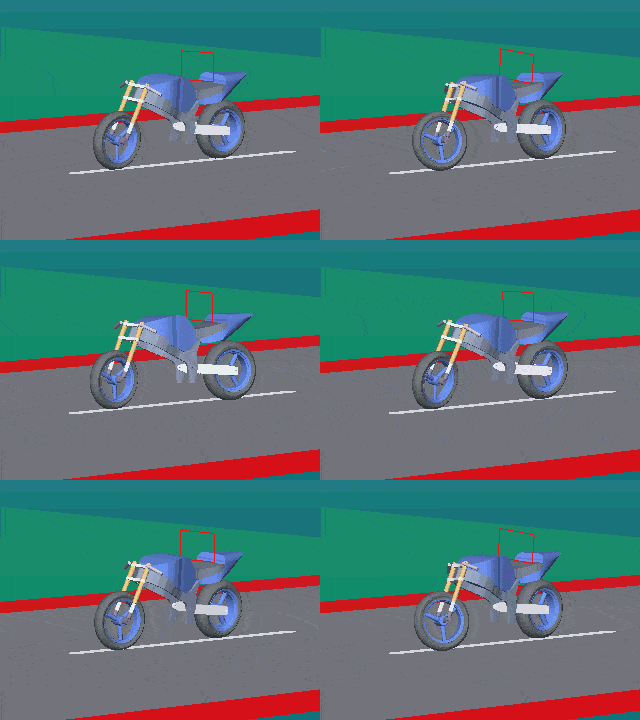

In these two animations you can see the two most common effects: the weave effect and the shimmy effect.
In the weave effect, the front end and the rear oscillate in opposite directions to one another. There is no twisting or flexing of the frame. But in the shimmy effect, once it reaches the resonant frequency everything gets more complicated. The oscillations grow in the front of the bicycle and diminish at the rear. This makes sense: the front assembly of the bicycle (the stem, the fork and the wheel) is the part with the most freedom of movement.
When the front of the bicycle accelerates in one direction during the oscillation, the rear of the bicycle accelerates in the opposite direction, turning the bicycle beneath you. Meanwhile, the fork rotates upwards in the direction the wheel is pointing during the movement. The handlebars rotate downwards in the same direction, creating torsion in the front steering assembly. You can see it clearly in the diagram below.

Which bicycle characteristics cause the shimmy effect?
This effect started to make sense on bicycles when materials with different properties began to be combined: carbon fibre (which has the highest elastic modulus) and aluminium (which has the lowest elastic modulus). Although this phenomenon occurred with some frequency in the past, it has also happened with carbon frames fitted with carbon forks that have an aluminium steerer, and with aluminium frames fitted with carbon forks. The large difference in elastic modulus/stiffness between the frame and the fork will cause a certain incompatibility in their ability to damp out resonance.
Head angle
As you know, the head angle affects the bicycle’s behaviour in every situation. With a fork that has a rake below 45 mm and a head angle steeper than 74°, under braking the fork tends to seek a more vertical position and produces small rebounds that turn into the shimmy effect. These figures are uncommon on bicycles today, so there’s no need to worry.
Wheel centring and dish
It’s very important that the two wheels are aligned with each other, properly centred and dished. Otherwise, at high speeds the bicycle can suffer the shimmy effect.
Another aspect to consider in order to avoid the shimmy effect on the bicycle is the lacing pattern of the front wheel. When few spokes are used and they’re laced straight (radially), higher tension is required. This makes the wheel stiffer, and vibrations are transmitted more easily.
Tyres in poor condition
Tyres cracked from age, or squared off from use, also cause the shimmy effect. At high speeds, the negative effect produced by the wheels in contact with the tarmac causes vibrations, even in the rear wheel, which transmits the resonance effect to the steering.
Low pressure in the rear tyre also has an effect.

Play in the bicycle’s headset
As I mentioned earlier, the shimmy effect affects the bicycle’s steering. If the headset of our bicycle has play in it, it’s more than likely we’ll be affected by the shimmy effect.
While it’s true that play is less common in modern threadless headsets than in the old 1” type, it can still happen, so it’s always advisable to check headset play and the condition of the bearings during maintenance visits to your favourite workshop.
Aerodynamics
Riding behind a vehicle larger than you, or descending in a group sheltered by your teammates, affects aerodynamics. You’re inside a tunnel where there’s almost no air resistance.
The problem comes when you leave that tunnel, or slipstream, and enter a zone of turbulence. The steering takes such a hit that it can degenerate into the shimmy effect. This happens because of the loss of lift over the tarmac — yes, what you’re thinking: the bike begins a take-off sequence, like an aeroplane, and the first thing affected is the steering.
But don’t worry — it doesn’t mean you’ll take off and go flying; the tyre barely lifts off the tarmac.
This is one of the reasons on fast descents it’s wise to put weight over the front wheel and adopt the most aerodynamic position possible.
That pesky magnet
Some riders still live with the magnet on the front wheel of their bicycle. If that’s your case, remember to fit it on the opposite side from the valve. Although wheels are built to compensate for the added weight of the valve at that specific point, the ideal is to fit a magnet as small as possible to avoid the weight imbalance it creates.

How to avoid the shimmy effect on your bike?
The first thing to do to eliminate the shimmy effect on your bike is to correct all the mechanical points mentioned earlier.
But if you’re caught out by the dreaded shimmy effect, let me explain the best way to control it.
First of all, try not to panic. Although the experience can be terrifying, it’s easy to regain control of the bicycle. To do so, you’ll need to act on the whole system.
If the vibrations occur when you take your hands off the handlebars, put them back on carefully. That should stop the shaking.
If it starts while your hands are on the handlebars, resist the temptation to grip the handlebars tightly – that can only make things worse. You should hold the handlebars firmly, but without squeezing too hard and at the same time press your knees against the top tube. This allows your body to dampen the vibration.
By pressing your knees against the top tube you make the system stiffer, which raises the resonance frequency of the system and the shimmy effect stops. This means higher speeds are needed for the vibration to develop. In practice, this is good, because you’re not riding at that high speed — you’re riding at a lower one, so the vibration stops.
It’s important not to use the front brake; you should use the rear one very carefully. You can also adopt a more upright position so that your body acts as a brake against the air; by increasing aerodynamic drag your speed will drop.
You must resist the temptation to jump off the bicycle — it’s the worst thing you can do in this situation. Just try to keep control of the bicycle, not to fall, not to hit other vehicles or run off the road until you manage to slow down. The speed at which the shimmy effect usually disappears on a bicycle is below 50 km/h.
On roads with many bends it’ll be quite a difficult task, since you can’t use the brakes as you should, but the key is to stay calm and apply the methods described to stop the vibration and reduce speed safely.
If you manage that, it’ll all amount to nothing more than a big scare.
References: Wikipedia – Ciclismo a fondo – Cycling Tips