


Choosing a new bicycle is a major investment, and one of the biggest doubts any rider has is… will I get the size right? A mistake here can lead to months of discomfort, pain, possible injuries and, worst of all, not enjoying your passion.
The solution to this problem has a first and last name: Stack and Reach. Forget generic sizes like S, M or L for a moment. These two measurements are the true ‘ID’ of a bicycle frame and the key to knowing whether it fits your body like a glove.
In this definitive guide we’ll show you in simple terms:
- What Stack and Reach are exactly and why they matter so much.
- How to calculate your body measurements to know what you need.
- The 3 methods for finding your ideal Stack and Reach.
- How to interpret these numbers to choose the perfect bicycle for you.

What exactly are Stack and Reach?
Imagine you can draw two lines from the centre of the bottom bracket (where the cranks meet).
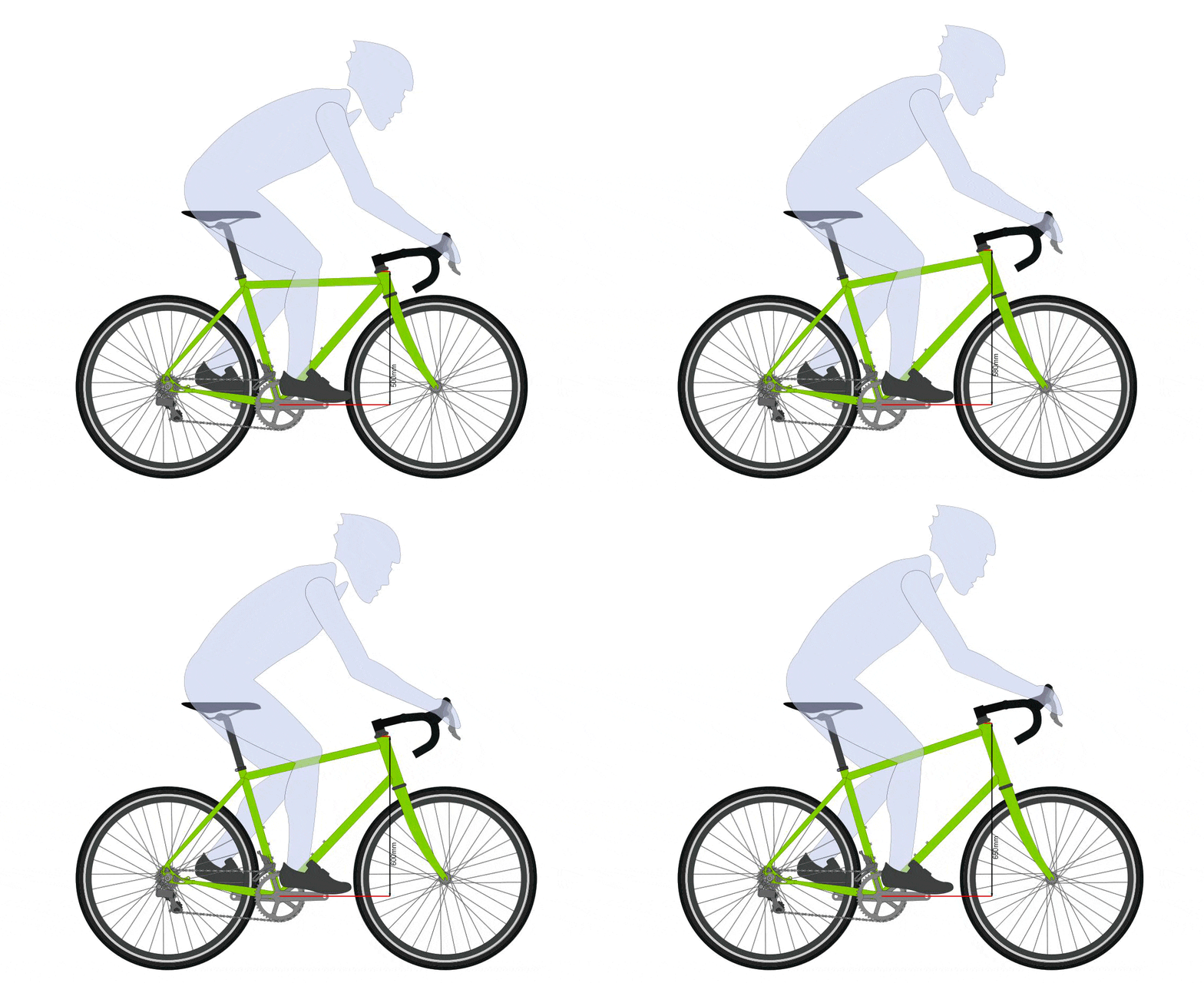
- Stack (height) is the vertical distance from the centre of the bottom bracket to the top centre of the head tube. It tells you how ‘high’ the handlebars or the front end of the frame is. A greater Stack means a more upright, comfortable posture.
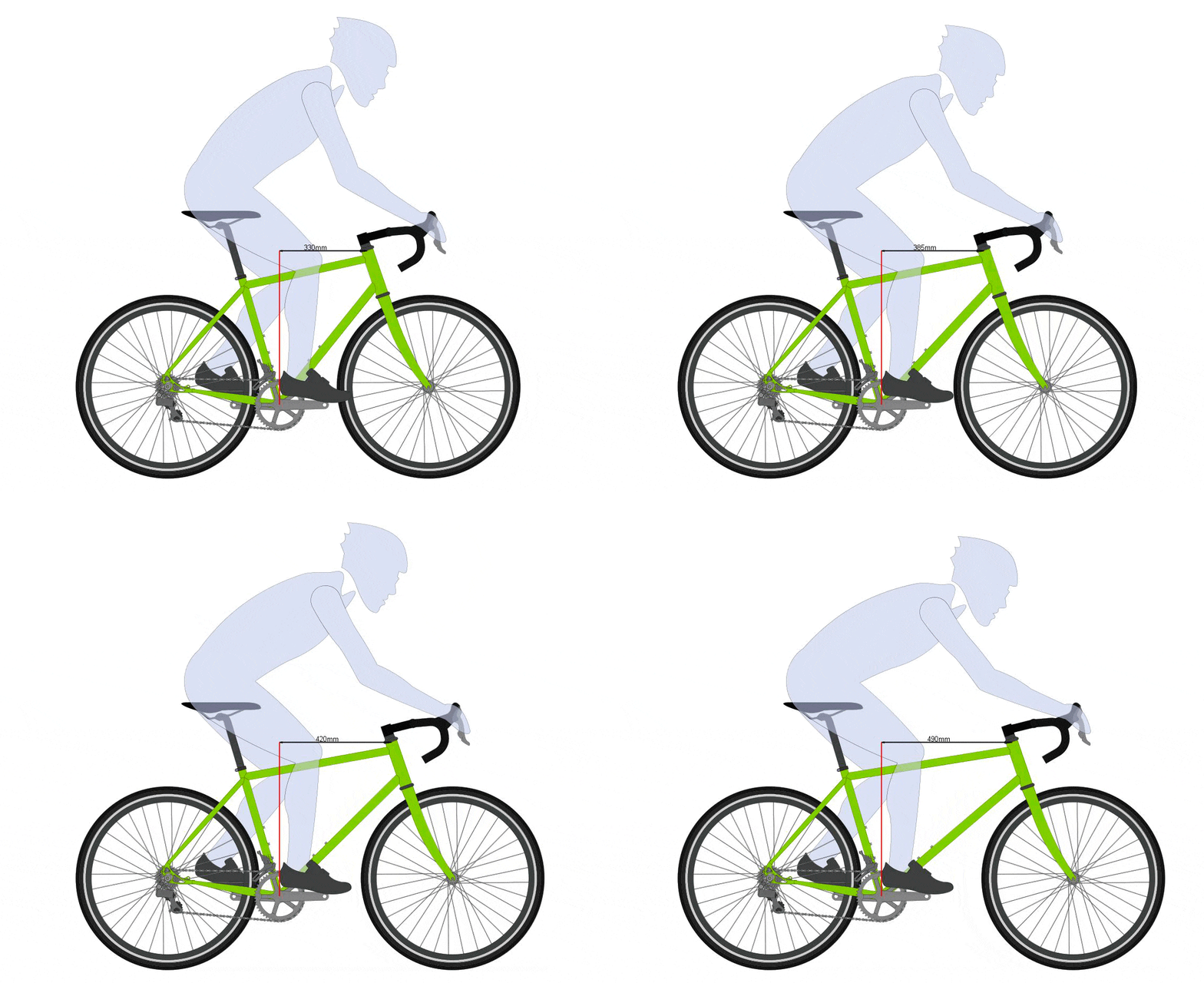
- Reach is the horizontal distance from that same point (the bottom bracket) to the top centre of the head tube. It tells you how ‘long’ the frame is. A greater Reach means you’ll ride more stretched out on the bicycle, in a more aerodynamic or aggressive position.
These two measurements define the position you’ll adopt on the bike, which is why they’re far more reliable than a simple size.
Stack
Reach
Why are they more important than frame size (S, M, L)?
Traditional sizes such as 54, M or 17″ are a legacy of the past. The problem is that they aren’t standardised. An M from one road bicycle brand can be completely different from an M from another gravel brand.
Basing your choice on Stack and Reach gives you direct benefits:
- Maximum comfort: geometry tailored to your body is the best prevention against typical back, neck, shoulder and wrist pain.
- Greater performance: a bike built to your measurements lets you apply all your power efficiently with every pedal stroke, without wasting energy on a poor riding position.
- Control and safety: a good fit gives you total control and predictable handling.
- A smart investment: you ensure every euro you put into your new bicycle is worth it.
How to calculate your Stack and Reach: 3 detailed methods
Method 1: the DIY approach (to narrow down sizes without paying for a bike fit)
This method will help you get a good starting point for your bicycle.
What you’ll need:
- A tape measure.
- A hardback book.
- A wall (and, if possible, someone to help you measure).
Step 1: measure your inside leg (E)
- Stand up, barefoot, with your back and heels against the wall.
- Place the hardback book firmly against the perineum, pressing upwards.
- Measure from the top edge of the book to the floor. That’s your inside leg (E) in centimetres.
Step 2: choose the riding position you’re after
| Position | Typical use | Stack/Reach ratio (approx.) |
|---|---|---|
| Relaxed / Endurance | Endurance road, touring | 1.55 – 1.60 |
| Sporty | Fast group rides, hard endurance road rides | 1.45 – 1.50 |
| Aggressive / Aero | Racing, criteriums, triathlon | 1.35 – 1.40 |
Step 3: calculate your target Stack
Stack (mm) ≈ 0.67 × E (cm) × 10
The factor 0.67 (roughly 2/3) has been used for years to estimate frame size from inside leg.
Step 4: calculate your target Reach
Reach (mm) ≈ target Stack (mm) / chosen ratio
This way you’ll keep the geometric ratio that best suits your riding position.
A worked example:
Let’s imagine a rider with:
- Inside leg (E) = 85 cm.
- Looking for a sporty riding position (choosing a ratio of 1.48).
- Calculate the Stack: Stack = 0.67 × 85 cm = 56.95 cm → 569.5 mm.
- Calculate the Reach: Reach = 569.5 mm ÷ 1.48 ≈ 385 mm.
A size 56 frame with a ‘race’ profile matches those numbers almost to the millimetre.
Step 5: cross-check against a real bike
Once you have your target Stack and Reach:
- Look up the Stack and Reach values in the geometry chart of the frame you’re interested in.
- Stack: if the frame’s Stack is within ±15 mm of your target, you can fine-tune the handlebar height using between 0 and 25 mm of headset spacers.
- Reach: a stem of between 80 mm and 120 mm gives you a range of ±20 mm of effective adjustment.
Remember:
- This method is only an initial filter and doesn’t replace a professional bike fitting.
- Your flexibility, previous injuries and the discipline can shift your ideal range.
- If you notice back pain, shoulder pain, hand numbness or other discomfort, see a professional.
Method 2: online calculators (the quick option)
If you don’t want to do the calculations by hand, there are online tools that do it for you. The idea is the same as the DIY method, but automated: you enter your inside leg and target riding position, and you get the approximate Stack and Reach values.
Method 3: professional bike fitting (the most thorough option)
This is, without doubt, the most accurate and advisable method, especially if you race, spend many hours on the bike or have recurring discomfort.

A professional bike fitting doesn’t just calculate your ideal Stack and Reach; it also takes into account your flexibility, injury history, goals and pedalling style. An expert will use advanced technology to find your perfect coordinates.
It’s the difference between a tailored suit and one bought off the rack.
I’ve calculated my measurements — now what? Interpreting the results
Great! Now you have your numbers. The next step is to look at the geometry charts of the bikes you like and compare.

But there’s one extra figure that will help you understand the type of bicycle you’re looking at: the Stack/Reach ratio (STR, or Stack To Reach Ratio). It’s calculated simply by dividing the Stack by the Reach of a frame.
STR = Stack / Reach
| STR value | Geometry type | Rider position | Ideal for… |
|---|---|---|---|
| Low (< 1.45) | Racing / Aggressive | Very forward, aerodynamic | Racing, riders with great flexibility |
| Medium (1.45 – 1.55) | Endurance / Balanced | Slightly forward, balanced | Most riders, long rides, cyclotouring |
| High (> 1.55) | Comfort / Relaxed | Upright, comfortable | Riders seeking maximum comfort, relaxed gravel riding |
Now you can look for a bicycle whose Stack and Reach match your body measurements and whose STR aligns with the type of cycling you want to practise.
What size bicycle do I need?
Now you know what your Stack and Reach, and STR are. You know how to calculate them, how they affect the bicycle and the rider. Now you need all the details and answers to the question we all ask ourselves when buying a new bicycle.
Measurements such as seat tube length or top tube length were once decisive in determining the size of bicycle you needed. But they didn’t help to work out the position you’d be in on the bike.
Thanks to Stack and Reach, makers have agreed to use this tool to help you determine the position you’ll have on the bicycle and, with it, the right size of bike for you.
Every maker has its own size charts with the corresponding geometries. You can’t determine your size without knowing what Stack and Reach you need.
The main front triangle is made up of the top tube, seat tube, down tube and head tube. Based on the measurements of these tubes, and the angles of the Seat Tube and Head Tube, we’ll adjust the cockpit dimensions. But the most important thing is the need for a meticulous study of the measurements of those tubes.
Calculating Stack and Reach on road and MTB bikes
More questions? Don’t worry — there’s no difference.

They’re calculated and apply in the same way across all cycling disciplines. But remember what we saw about the Stack To Reach Ratio.
The Stack and Reach on a road bicycle are similar to those on a cyclocross bicycle, and the Stack and Reach on an MTB to those on a gravel bike. Just to give you a quick idea.
Are Reach and Stack important when building a custom bicycle?
Yes.
With these two measurements and the STR (Stack To Reach Ratio), you can create the perfect cockpit for the rider.

The cockpit is the area that defines your position as a rider on the bicycle, with the three contact points: saddle, handlebars and pedals. If that position suits your physiology and biomechanics as a rider, the bicycle will be perfect.
Reaching that point isn’t easy: it takes a bike fitting and exhaustive work on the frame geometry. It means setting the overall character of the bicycle and your preferences for how it behaves in each situation. The optimal, perfect result is always achieved through craftsmanship and a detailed study of every point.
Explanatory video
Frequently asked questions (FAQ)
Are Stack and Reach the same for a road bike as for a mountain bike (MTB)?
Not necessarily. The geometries are very different. An MTB usually has a higher Stack and a shorter Reach to offer more control on technical terrain, whereas a road bike aims for a more aerodynamic position. You should always compare bikes of the same discipline.
Can I modify the Stack and Reach of my current bicycle?
Yes, up to a point. You can ‘play’ with the Stack by adding or removing headset spacers, or by flipping the stem. You can slightly modify the Reach by using a shorter or longer stem. However, these are fine adjustments; they cannot correct the wrong choice of frame size.
Which is more important, Stack or Reach?
Both are crucial and work together. You can’t choose one over the other. They are like the coordinates on a map: you need both to know where you are. Focusing on only one of the two measurements is a common mistake that leads to a poor choice.
Conclusion
We hope this guide has clarified the importance of Stack and Reach for you. They are much more than mere numbers in a geometry table: they are your assurance of finding a bicycle on which you’ll enjoy every kilometre.
From now on, whenever you look at a new bicycle, always look for these two measurements. They’ll be your best allies in making an informed, intelligent and sound decision.
Still have doubts, or would you like an expert to help you interpret your figures? Don’t hesitate to get in touch with our team.