


The stem is the part that joins the handlebars to the fork. Its length and angle change your position, stability and agility. Get to know the types so you choose the right one for your next purchase.
What is the bicycle stem and what is it for?
The bicycle stem is a fundamental component that connects the handlebars to the fork’s steerer tube. Its main function is twofold:
- Connect and secure: it holds the handlebars to the bicycle, transmitting the rider’s steering input to the front wheel.
- Adjust your position: it lets the rider change their position on the bicycle, directly affecting comfort, aerodynamics, pedalling efficiency and overall control. A stem with the right length and angle is crucial for good ergonomics and for preventing pain or fatigue on long rides.
In short: the stem is key to your bicycle’s ergonomics and control.
Its job is to keep the steerer tube and handlebars joined together. You’ll be able to see this much more clearly in the photo below.

Right, now you know what the stem is. Let’s get to work with it.
Parts of a bicycle stem: get to know its components
A bicycle stem, although it seems simple, is made up of several essential parts that work together:
- Body (or shaft): the main structure of the stem that extends from the fork to the handlebars.
- Fork clamp: the end of the stem that grips around the fork’s steerer tube, usually with two bolts.
- Handlebar clamp: the front end that holds the handlebars. It can be made up of one or several pieces and is tightened with bolts.
- Adjustment bolts: these allow the stem to be tightened and secured to both the fork and the handlebars. It’s crucial to tighten them to the recommended torque.
- Headset top cap (on Ahead stems): a top cap that is tightened against the steerer tube to remove play in the headset before tightening the fork clamp bolts.
What are the dimensions of a bicycle stem?
The dimensions of a bicycle stem are:
Steerer tube diameter
It can come in different sizes, although the current standard across 99.99% of the industry is 1 1/8″, which equals 28.6 mm. Other sizes exist on entry-level or older bicycles, such as 22.2 mm or 25.4 mm. It’s worth noting that Cannondale has used 1.5″ for many years on its mountain bikes, since the steerer tubes on its Fatty and Lefty forks are built in that size, although the trend is now shifting towards the more conventional measurement.

Handlebar diameter
I don’t think this measurement needs much explaining. The most common size is 31.8 mm. On downhill and enduro bicycles, 35 mm handlebars are starting to appear; these add stiffness to the assembly and reduce weight very slightly. On older bicycles and on some current entry-level ones, 25.4 mm handlebars are used.

Rise angle
As the name suggests, it represents how many degrees of rise the stem has relative to its horizontal line. The rise can be positive or negative, although the vast majority of stems can be flipped between positive and negative simply by turning them over. This lets us vary the rider’s position on the bicycle and the way it handles. We’ll look at that later on.

Stem length
This measurement isn’t the overall length of the stem, as many might think. To take it, we measure from the centre of the steerer tube clamp to the centre of the handlebar clamp. For example, a 100 mm stem has a centre-to-centre length of 100 mm, regardless of the overall length, which doesn’t determine how the bicycle handles or the rider’s position on it.

How many types of bicycle stem are there?
Setting aside dimensions like handlebar diameter, steerer or length, let’s look at the types of stems that exist.
Ahead stem
It’s the most common bicycle stem in use today, with one clamp on the fork’s steerer and another on the handlebars. Lengths range from 0 mm (Mondraker Forward Geometry) up to 130-140 mm, and you can even find some slightly longer. Another point to highlight is the rise angle: they range from 0° up to 32°. The angle can be negative by flipping the stem, as we saw earlier. There are also custom bicycle stems where any possible characteristic can be achieved.

Quill stem
Used on vintage bicycles and currently on some entry-level city bicycles. Rather than clamping around the steerer tube as Ahead stems do, these slide inside the steerer tube. They have a bolt that, when tightened, presses against the wedge at the lower end to lock it in place.
There’s another model used on vintage bicycles that, instead of a wedge, has a cone. As the bolt is tightened, the cone rises inside the stem and, thanks to two slots in its body, expands to lock everything in place.

Adjustable bicycle stems
As the name suggests, they’re adjustable, but only in angle. They can be Ahead or quill stems. They work via a toothed mechanism with different positions. A bolt, when tightened, holds the stem fixed in the chosen position and, when loosened, allows the angle to be changed. Some models have a safety bolt at the bottom; unless it’s loosened, the stem won’t move from its position.

Adjustable tandem stem
This type of stem is very specialised and is used on the rear cockpit of tandems. The angle is fixed, but the length is adjustable.

Direct-mount stem
This type of stem is used on downhill bicycles. It mounts directly to the fork’s upper crown. It works the same way as an Ahead stem, with the added benefit that in a crash the handlebars won’t twist.

Now that we’ve seen the types of stem available and their different dimensions, let’s look more closely at how length and angle affect the behaviour of the bicycle and the rider’s position on it.
How the stem affects your posture and performance
Stem length is closely related to top tube length (Top Tube), as we saw in the post on all the details of bicycle geometry. But it can also alter your Reach.
Would you like to know your Stack and Reach? Here’s a post where I explain them in full detail: What are my Stack and Reach?
Top Tube length has been increasing of late. This is most evident in mountain, gravel and cyclocross bicycles, although it’s now visible in some road bicycles too. This added length helps balance body weight over the bicycle, but it does require shorter stems. These changes improve pedalling performance and front-wheel grip in corners, and they increase the wheelbase, improving stability.
Stem choice significantly influences how you feel on the bicycle and your performance:
Impact on comfort
- Shorter/higher stem: raises the handlebars and brings them closer to the rider, resulting in a more upright, comfortable posture, ideal for recreational rides or riders with back problems.
- Longer/lower stem: stretches the rider out and tilts them forward, favouring a more aerodynamic, aggressive posture, common in road cycling or competition.
Influence on handling and agility
- Shorter stem: makes steering faster and more agile, ideal for mountain bicycles on technical trails where a quick response is needed.
- Longer stem: offers more stable, less twitchy steering, preferable on road bicycles for holding your line at high speeds or over long distances.
Relationship with pedalling power (watts)
It’s important to clarify that the “bicycle’s stem” (the component) is different from “pedalling power” (measured in watts). While a posture optimised by the stem can contribute to greater pedalling efficiency, pedalling power refers to the force and speed with which the rider generates energy. Properly setting up the stem can help transfer that energy more effectively.
But let’s focus on stem length and set the other measurements aside.
This measurement will affect two specific things:
How the bicycle handles
When you change the length, the weight on the front wheel changes too. The longer the stem, the more weight sits on the front wheel, making the bicycle more stable.

The ideal has always been for the rider’s weight on the front wheel to sit as centred as possible over the wheel’s axle. That said, as I mentioned earlier, all of this is affected by top tube length and even by fork rake.
A fork’s rake is the offset of the wheel axle ahead of the head tube line. Rake affects steering behaviour and characteristics such as agility, stability and handling.
Something often overlooked is how the handlebars’ turning angle is affected by different stem lengths. Let me try to explain it simply: a short or long stem changes steering behaviour in terms of stability, but it also affects agility and handling regardless of fork rake. Why?
Steering, which is tied to the bicycle’s handling, depends on the head angle and the trail. A short stem will make the steering more responsive, while a long stem will dull that responsiveness. On the other hand, if for example the head angle is too slack, a long stem can make the bicycle feel sluggish to react.
In this diagram you can see how, to generate a 30° angle, the distance you need to turn the handlebars is smaller or larger depending on the stem length.

When designing the geometry to build a bicycle frame, all of these values have to be taken into account. For example, in geometries for women’s bicycles we have to be very careful with the head angle, the reach, the top tube length and the stem length. All of this affects the wheel’s turning arc and can cause it to strike the foot.

To sum up:
- A long stem improves control on climbs by making the steering slower and more forgiving. As a result, it increases the bicycle’s stability.
- A short stem improves safety on descents and gives you more agile steering, but in exchange you reduce the bicycle’s stability at high speeds. That last point works against the safety gains on descents whenever speed is high.
The rider’s position on the bicycle
To give you an idea, varying the length of the stem would be like modifying the top tube length or the reach. But really it only affects the position on the bicycle.
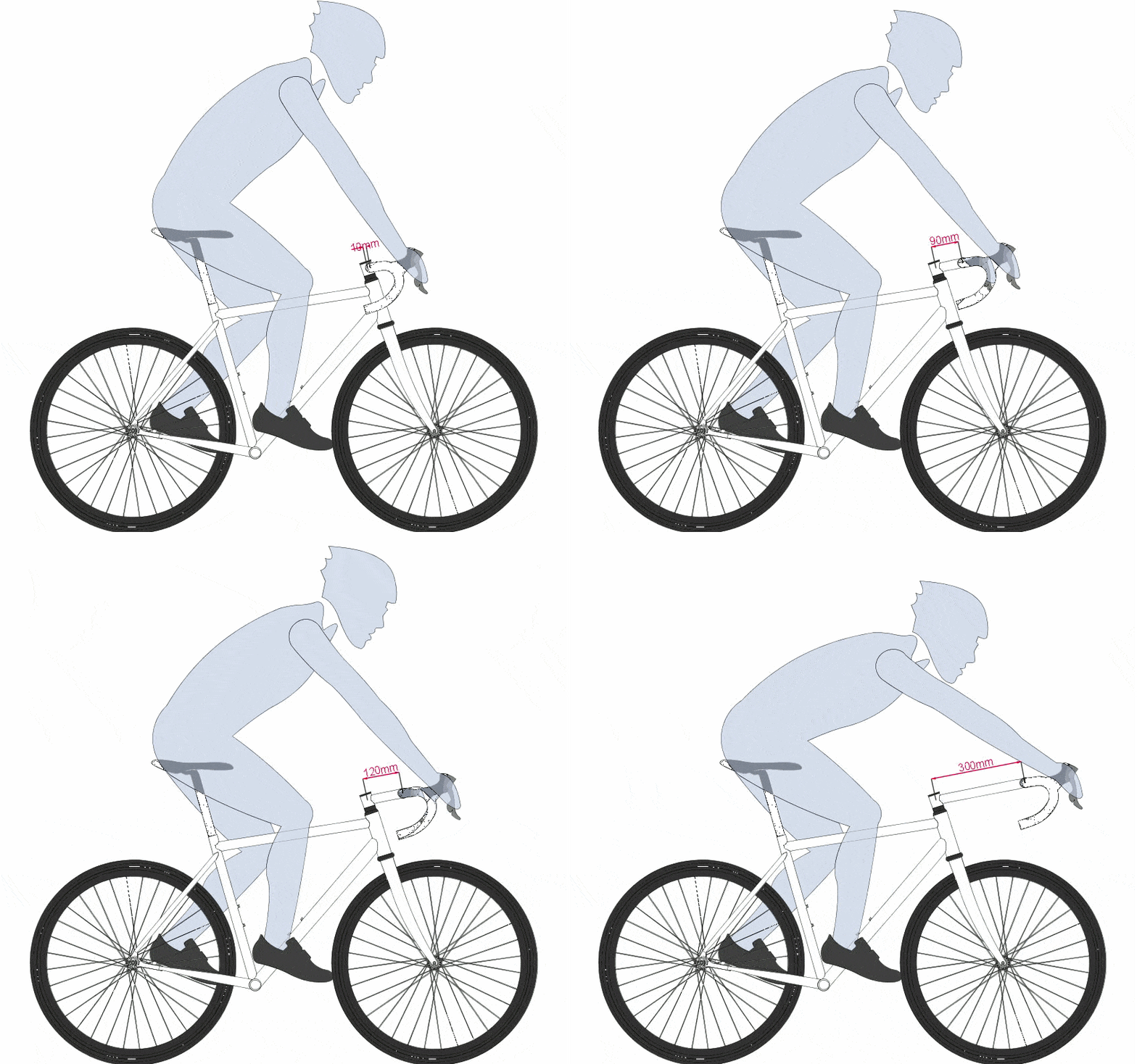
How does it affect the rider’s position? Let’s take it step by step. In terms of the bicycle’s handling, as we increase the length from the centre of the saddle relative to the centre of the handlebars, handling will decrease. And on the biomechanical side, the rider will be more stretched out, with straighter arms and a more flexed back, so the position will be more aerodynamic — or in some cases forced, depending on their flexibility.

Conversely, if we decrease the length, the bicycle will be easier to control and the rider’s position will be more comfortable and upright. You’ll be able to see this much better in this graphic: it uses two very extreme measurements (0 mm and 300 mm) so the difference is clearly visible.
Long stem vs. short stem: which one should you choose?
This is one of the most common decisions when fitting the stem, and the choice depends largely on the type of cycling and the rider’s physique.
Long stems for road (or endurance cycling)
- Length: generally between 90 mm and 140 mm.
- Benefits: they promote a more stretched, aerodynamic position, reduce muscular fatigue in the lower back over long distances by distributing weight better, and offer more stable steering for riding at high speeds or in groups.
- When to choose them: ideal for road cycling, triathlon, or if you’re after an aggressive, aerodynamic posture.
Short stems for MTB and gravel (or technical cycling)
- Length: typically between 35 mm and 70 mm.
- Benefits: they offer more direct, reactive steering, better control on technical descents and winding trails, and make it easier to lift the front wheel. They allow a more upright posture, improving visibility and confidence on difficult terrain.
- When to choose them: essential for mountain bikes (enduro, trail, downhill) and increasingly popular on gravel bikes for their agile handling.
How to measure your bicycle’s stem: a step-by-step guide
Measuring your bicycle’s stem is a simple process that will help you choose a replacement or understand your current set-up.
Tools required
- Tape measure or ruler.
- (Optional) Spirit level.
Measurement process
- Length: measure the horizontal distance from the centre of the steerer tube (where the stem clamps to the fork) to the centre of the handlebar clamp. This is the stem length, usually expressed in millimetres (mm).
- Angle (or rise): this is more complex and is often marked on the stem itself (e.g. ±6°, ±17°). It’s measured from the horizontal. A positive angle raises the handlebars; a negative one lowers them. You can use a spirit level to estimate the tilt if it isn’t marked.
- Handlebar clamp diameter: measure the diameter of the handlebar where the stem clamps it (the most common standards are 25.4 mm, 31.8 mm and 35 mm).
- Fork clamp diameter: measure the outer diameter of the fork’s steerer tube where the stem clamps (common standards are 1 1/8″ for Ahead, and 1″ or 1 1/8″ for quill).
Additional considerations when choosing a stem
Beyond length and type, there are other factors to bear in mind:
- Handlebar clamp diameter: it must match your handlebar’s diameter exactly (e.g. 31.8 mm is very common).
- Fork clamp diameter: make sure the stem is compatible with your bicycle fork’s steerer tube diameter (e.g. 1 1/8″ is the current standard for Ahead stems).
- Stem angle: decide whether you need a stem that raises or lowers the handlebars to refine your position. Common angles are ±6°, ±10°, ±17°.
- Material and weight: stems are usually made of aluminium (more affordable and durable) or carbon fibre (lighter and stiffer, but more expensive).
Frequently asked questions
Here we answer some of the most common questions about the bicycle stem:
- What is the main function of the bicycle stem? To connect the handlebars to the bicycle’s fork and allow the rider’s position to be adjusted.
- How do I know what stem size I need? It depends on your body shape, the type of bicycle and your cycling style. A longer stem will stretch your position; a shorter one will shorten it. The best approach is to try and adjust according to comfort.
- Is a bicycle stem the same as cycling watts? No. The “bicycle stem” refers to the component (stem) that joins the handlebars to the fork. “Cycling watts” refer to pedalling power — the energy the rider generates.
- Can I change my bicycle’s stem myself? Yes, it’s possible, but it requires specific tools (Allen keys and a torque wrench) and some basic knowledge. If you’re not sure, it’s advisable to take it to a professional workshop.
- How does the stem affect aerodynamics? A longer stem with a negative angle allows a lower, more stretched-out position, which reduces wind resistance and improves aerodynamics.
Conclusions
When a rider decides to buy a new bicycle, they have no option to choose the stem length so as to adapt it to their biomechanical needs. The only route would be to reach an agreement with the shop to swap it, and in the vast majority of cases that isn’t possible.
As you’ve seen, the stem length of the bicycle is fundamental to its handling and to the rider’s position on it. The big brands match stem length to frame size to achieve a balance. That decision is taken on the basis of the bicycle’s geometry, not the rider’s biomechanics.
Some will recommend that long stems are better on road bicycles (because the position is more aerodynamic) and shorter ones on mountain bikes (the better to deal with technical obstacles). On the basis of the handling and function of a road or mountain bike, that would be a fair statement. It would, however, be entirely wrong if we focus on what really matters: the rider–bicycle relationship.
Being able to refine and adjust this relationship down to the millimetre is one of the benefits of building custom frames. Working from the rider’s biomechanics when designing the frame geometry lets us arrive at the correct stem length that the rider–bicycle pairing needs. That’s how we achieve the right rider position and the right handling from the bicycle. There may even be cases where a custom stem must be built to reach perfection.
The stem on your bicycle is a small component with an enormous impact on your cycling experience. Choosing the right stem for your physique, riding style and type of bicycle can radically transform your comfort, control and performance. Take the time to measure, understand the different types and, if needed, experiment to find the perfect fit that lets you enjoy every pedal stroke to the full.
Want a position tailored to your biomechanics?
If you’ve made it this far, you may be having trouble with the stem on your bicycle or discomfort when riding it. I have the solution for you.
Many people think a custom bicycle is within reach of only a few, but Oxia breaks the stereotypes. I’m here to help you keep enjoying cycling.
Article revised on 12 June 2025.