


All the details of bicycle geometry
Since bicycles were invented, their design has evolved with one purpose: to meet the rider’s needs and improve performance regardless of the discipline. Today there are many types of bicycle for different riding styles, and the differences between them are bound up with performance and quality. Many of those differences relate directly to the dimensions of the frame — dimensions that make up the geometry of a bicycle.

Seat tube length
This is the distance from the centre of the bottom bracket (BB from here on) to the highest point of the tube. This measurement usually defines the size of the bicycle; depending on the brand, it’s expressed in centimetres or in inches. On full-suspension bicycles a virtual seat tube length (ST from here on) is also given, because the actual length doesn’t represent the size — owing to the shapes used in the tubes to accommodate the linkage pivot points.
There are two measurements for the ST:
- Centre-to-Top (ST C-T, shown in the image as 513 mm). Used for the size of the frame.
- Centre-to-Centre (ST C-C, shown in the image as 474 mm). Used for building the frame and for determining the drop or sloping of the top tube.
In recent years, frame size has tended to be defined by more precise measurements such as stack and reach — two figures we’ll look at later on.

Seat tube angle

- Road: between 73° and 76°.
- Triathlon or time trial: between 76° and 78°.
- Cyclocross: between 72° and 75°.
- Gravel: between 73° and 74°.
- XC: between 73° and 75°.
- Marathon or trail: around 73°–74° is the most common.
- Enduro: varies between 74° and 76°.
- Downhill: we find very different figures, from 73° to 78°.
Head tube length
This is one of the measurements that sets the ergonomic brief of the frame. Head tube length (HTL) gives us the height of the front end of the bicycle and, in doing so, changes the rider’s position.

Head angle
This is the angle the head tube forms relative to the horizontal plane (the ground). It directly influences how the bicycle behaves. A very steep head angle helps on climbs and stays stable on flat sections, with a more comfortable position and easier handling; it also gives the bicycle a more direct, lively and unstable steering character on descents. A slack head angle is used on enduro and downhill bicycles, where we need the bicycle to be stable and to attack obstacles confidently.
- Road: between 70° and 74°.
- Triathlon or time trial: between 70° and 72°.
- Cyclocross: between 69° and 73°.
- Gravel: between 70° and 73°.
- XC: between 68° and 69°.
- Marathon or trail: around 66°–68° is the most common.
- Enduro: varies between 63° and 64.5°.
- Downhill: we find very different figures, from 61° to 63°.

Top tube
This is the tube that joins the head tube and the seat tube. Its length determines the distance from the centre of the HT to the centre of the ST. Its value varies with the size of the bicycle — the larger the size, the longer the tube.
These days, top tube length has been growing; we see it most on mountain bike, gravel and cyclocross bicycles, though it’s also starting to appear on some road bicycles. This extra length helps balance body weight over the bicycle — though it does require shorter stems. These changes improve pedalling performance and front-wheel grip through corners and, alongside the longer wheelbase, increase stability.

- Top Tube Centre-to-Centre: measured from the centre of the HT to the centre of the ST. This is the tube length used for building the frame.
- Top Tube Horizontal: this used to guide us when choosing a bicycle because it defined the size. We all remember the old trick — still used today — of resting your elbow on the tip of the saddle and extending your fingers to touch the centre of the head tube. These days it’s hardly used, since reach (which we’ll look at later) defines the frame size more accurately.
Bottom bracket height
It’s the vertical distance from the centre of the bottom bracket to the ground. It determines how much room the bicycle has to clear obstacles without striking the frame or chainrings. A decisive factor in the bicycle’s stability and handling, which affects things as follows:
- Low bottom bracket height: the bicycle is more stable, since its centre of gravity is lower, and inspires greater confidence.
- High bottom bracket height: the bicycle becomes more reactive, but at the same time less stable.
Common values:
- XC: between 29 and 31 cm.
- Marathon or trail: 31-33 cm is the most common range.
- Enduro: varies between 33 and 35 cm.
- Downhill: from 35 up to 36 cm.
- Road: ranges between 26 and 27 cm.
- Triathlon or time trial: 26 cm is typical.
- Cyclocross: between 28 and 29 cm.
- Gravel: between 27 and 28 cm.


Bottom bracket drop

The evolution of bicycle design is shaping the broader shift in geometry figures, and this parameter is no exception. Tyre size, for example, has been one of the key factors, alongside new research grounded in rider biomechanics.

Once you understand how a bicycle’s geometry works, you can imagine that altering this figure affects most of the frame’s dimensions. But this doesn’t only happen with bottom bracket drop; this peculiarity applies to many of the dimensions. Some are even determined by the others.
Chain stay length
It’s the length between the centre of the bottom bracket and the centre of the rear wheel axle. A length that makes the bicycle more or less stable and, at the same time, quicker or slower on climbs and descents.
Like the other figures, it has also evolved over time. Short chain stays reduce stability while delivering better reactivity and a sharper ability to tackle climbs. Long chain stays, on the other hand, make the bicycle much more stable, though slower and less reactive on technical climbs.
- XC: between 42 and 44 cm.
- Marathon or trail: 43 to 44 cm is the most common range.
- Enduro: varies between 44 and 45 cm.
- Downhill: from 44 up to 46 cm.
- Road: between 41 and 42 cm.
- Triathlon and time trial: typically around 40-42 cm.
- Cyclocross: between 43 and 44 cm.
- Gravel: between 42 and 44 cm.

Reach
Imagine a vertical line passing through the centre of the bottom bracket. Reach is the horizontal distance from that line to the top centre of the head tube.
Remember when I mentioned the horizontal top tube figure?
Horizontal Top Tube… These days this figure is barely used, since there’s reach, which we’ll look at later on and which better determines bicycle size.

This figure, together with stack — which we’ll see later on — makes up the cockpit. The two are linked to each other. For example, the greater the reach, the more stretched-out the rider’s position on the bike will be.

But as I say, this is just an example, since other factors come into play — stem length, seat tube angle, and so on.
Stack
Stack, or frame height, is the vertical distance between the centre of the bottom bracket and the top centre of the head tube.
As I mentioned earlier regarding reach:
…together with stack…they make up the cockpit. The two are linked to each other.
These are the figures that currently best define a frame’s size. This is due to the arrival of the much-discussed top tube sloping, where in the past this tube was a straight line joining the head tube and the seat tube. Now, the more sloping we have, the shorter the seat tube becomes, leading many riders to think the bicycle is a smaller size. The value can be modified, or adapted, by changing the stem angle or altering the height of the headset spacers.

If we look at bicycle geometry, we can see that a road bicycle designed for racing or endurance riding has a greater reach than a track one. This puts the rider in a more stretched-out position, creating a lower profile, which improves aerodynamics.
Here’s a representation of the two figures, stack and reach, so you can see how they form a perfect square that defines the space the rider has to settle into, and how that position shifts as the figures change.
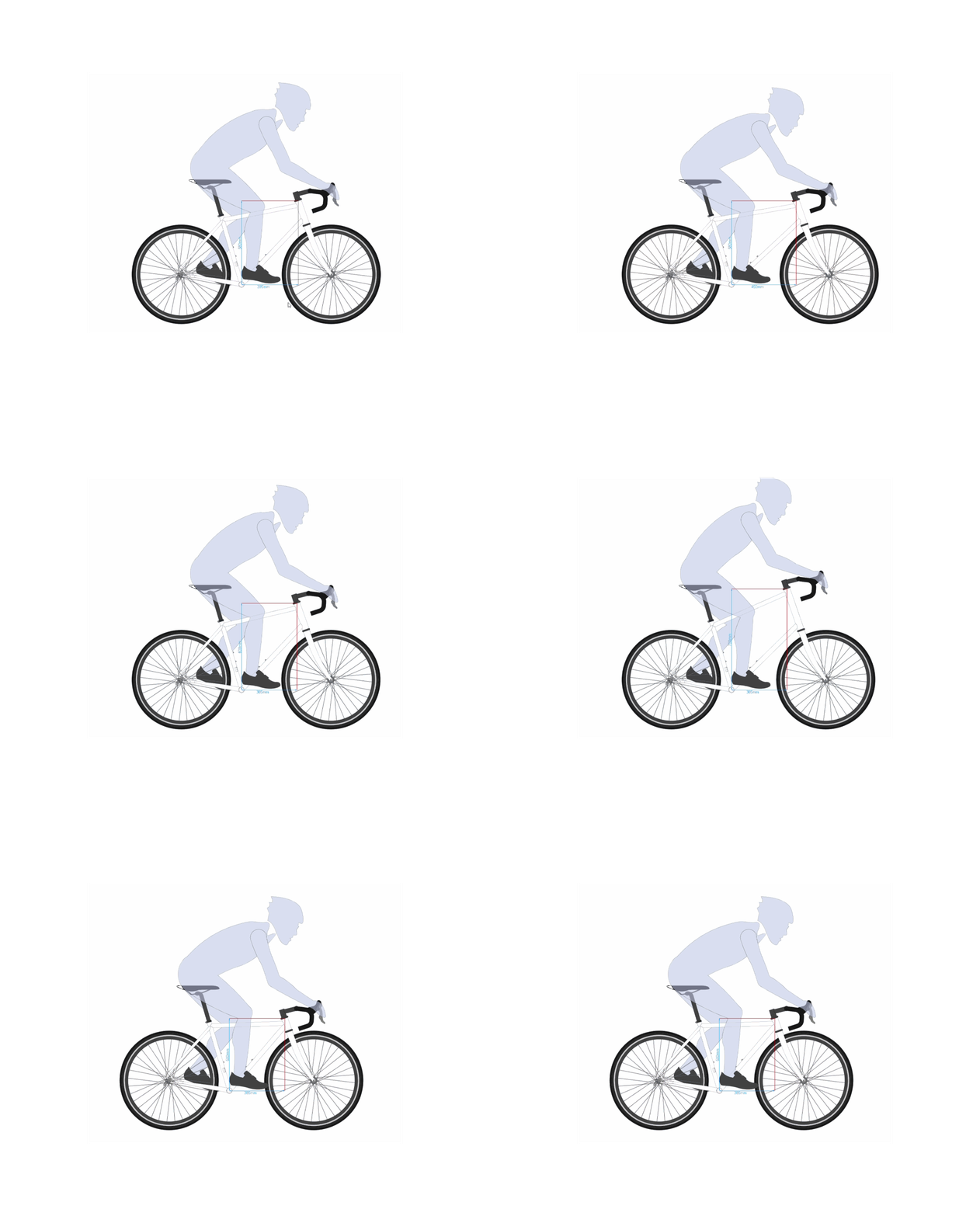
If you’d like to explore these two figures in more depth, you can read the post where I explain it in detail and even show you how to calculate your stack and reach.
Offset
This is one of the measurements that causes the most confusion in bicycle geometry, along with trail. Offset is measured by drawing a vertical line through the front wheel axle and another extending the imaginary line of the head tube. The difference in distance between the two is the offset.
It’s difficult to grasp from reading it alone, but you’ll see how the image makes it much clearer.

You may be wondering how offset affects the behaviour of the bicycle. A greater offset gives the bicycle more stability, and vice versa.
Trail
At first glance it might look like the same measurement, but they’re nothing alike. The trail of a fork is the distance between the contact point of the tyre with the ground and where the imaginary line of the head tube meets the ground.
Let’s look at the diagram:

Has your brain short-circuited? Don’t worry, it’s normal — it happened to all of us the first time. Here’s another diagram that should make it much clearer. You can see how, with different variations in head angle, fork offset, wheel size and other combinations, the trail varies significantly.

So what now? Trail is often confused with fork rake. It’s a fundamental measurement in bicycle geometry, as it affects the handling of the front wheel. The greater the trail, the slower and more stable the steering at high speeds, but at the same time the bicycle will feel more sluggish through tight corners and harder to turn. Downhill bicycles, for example, have a high trail value.
To make the steering livelier and more responsive — with a corresponding gain in handling — we need to reduce the trail.
Wheelbase
In the automotive world this measurement is known as wheelbase. In bicycle geometry, it’s the distance between the centres of the wheel axles. Wheelbase has a significant effect on the behaviour of the bicycle, both in stability and in reactivity. A shorter wheelbase makes the bicycle quicker to react and more agile, but it also reduces its stability and, above all, its safety at high speeds. A longer wheelbase makes the bicycle slower or more sluggish through quick turns, but much more stable and safe at high speeds.

This measurement is related to chainstay length and fork offset. A longer or shorter chainstay alters the wheelbase, just as a different fork offset would. But now fork rake comes into play.
Rake
The rake of a fork is the forward distance of the wheel axle from the line of the head tube. You might say it’s the same as offset, but it isn’t — similar and related, yes. Rake affects steering behaviour and characteristics such as agility, stability and handling.
In short, rake, offset and trail go hand in hand. Rake is most widely used on mountain bike forks. The most common rake values today on suspension forks are 46 and 51 mm, though there are rigid forks at 44 and 52 mm. It was pioneered by Gary Fisher and called G2: it consists of lengthening the frames and shortening the offset, so that the difference between these two axes shows up in the trail. On head angles below 69–68.5°, makers turn to a smaller offset, since the idea of offset is to compensate for overly slack angles. If you’re looking to buy a road fork, these usually have a rake of 43, 45 or 50 mm. Some makers only offer one measurement and others several, even within the same model — but as I say, it depends on the maker and the fork model.


Conclusion
Bicycle geometry is a complex structure made up of multiple measurements, all related to one another. Any variation in one will affect the others, and therefore the way the bicycle behaves.
Large brands and mass-production bicycle makers don’t take into account each rider’s biomechanics, technical ability or specific needs. That’s where the value of a custom steel bicycle lies: every figure is adjusted and tailored to your needs like a glove.
A hand-built frame answers the need for something distinctive — a bicycle designed specifically for you. Hand-built steel frames are regarded as works of craft and, by not following market trends, they appeal to riders who look for design quality while meeting their biomechanics needs. On top of that, it will be a one-off piece, different from the factory bicycles used by the wider public.
A steel framebuilder focuses on finding the best geometry for the rider, making your bicycle as efficient and functional as anything you’ll find on the market.
When you decide to buy a steel frame, you become part of the entire build process. The result is a custom geometry and design, in a bicycle that will stay with you for life.